
Viscosity and temperature are directly related to how liquids flow. A liquid with high viscosity has more resistance to flow, so it usually flows more slowly than a liquid with low viscosity. At the same time, when temperature changes, the viscosity of a liquid can also change. This means the same liquid may flow differently at different temperatures.
This relationship is important in QC and laboratory testing because a viscosity result is meaningful only when the test temperature is known. Even when testing the same sample, the results may be different if the tests are carried out at different temperatures.
Viscosity Determines How Easily a Liquid Flows
Viscosity is the internal resistance of a liquid to flow. A liquid with high viscosity has more resistance to movement and usually flows more slowly. A liquid with low viscosity moves and flows more easily under the same conditions.
However, actual flow speed does not depend only on viscosity. It also depends on pressure, system design, pipes or flow channels, and temperature. For quality control, viscosity should therefore be considered together with the actual operating conditions, not only as a single viscosity value.
When Temperature Changes, Viscosity and Liquid Flow Also Change
For most liquids, viscosity changes when temperature changes. Therefore, viscosity results measured at different temperatures should not be compared without considering the test conditions.
Higher Temperature Makes Liquids Flow More Easily
In general, when the temperature of a liquid increases, its viscosity decreases. This reduces the resistance to flow and allows the liquid to flow more easily.
This behavior can be clearly seen in many oils and petroleum products. The relationship between viscosity and temperature is an important factor when evaluating the properties and performance of these liquids.
Lower Temperature Can Make Liquids Thicker and Harder to Flow
When temperature decreases, many liquids become more viscous. More force may then be needed to move the liquid or pump it through a system.
This is important for products used at low temperatures, such as lubricating oils and some fuels. Poor flow can affect pumping, circulation, or fuel flow inside a system.
Examples of Liquids Affected by Viscosity and Temperature
Common examples found in petroleum laboratories include lubricating oils, fuels, and greases.
Lubricating Oil
Lubricating oil needs the right viscosity for its operating conditions. It must be able to flow to the parts that need lubrication and form a suitable oil film between moving surfaces.
For this reason, viscosity is one of the key properties used to determine whether an oil is suitable for a specific machine or system.
When temperature increases, the viscosity of lubricating oil decreases, allowing the oil to flow more easily. On the other hand, if the temperature is too low, the oil can become more viscous and may not flow smoothly through the engine or lubrication system.
Fuel
Fuel viscosity can affect storage, pumping, delivery, and operating conditions.
When temperature decreases, fuel may become more viscous and may be harder to move through the system. When temperature increases, viscosity usually decreases, allowing the fuel to flow more easily.
Grease
Grease behaves differently from liquid lubricating oil because it has a semi-solid structure. A thickener is used to hold the lubricating oil inside this structure.
When temperature increases, grease can become softer and its flow behavior can change. If the temperature becomes too high, the grease structure may no longer remain stable.
Its viscosity can decrease, which may reduce its ability to stay on machine parts.
For quality control applications that require viscosity testing of oils, fuels, or other products under controlled temperatures, using an instrument that can monitor both viscosity and temperature can make test conditions easier to control.
The VISCOlab 3000 Viscometer has a built-in temperature sensor and can display both viscosity and temperature. It supports samples with different viscosity ranges and temperature conditions for various petroleum testing applications.
Viscosity Testing Methods
Viscosity testing is important in many industries because viscosity shows how much a liquid resists flow. This information can help evaluate the properties and performance of products such as lubricating oils, fuels, and greases.
-
Kinematic Viscosity Testing
Kinematic viscosity testing measures how a liquid flows through a small capillary tube.
The basic test process is:
- The liquid sample is drawn into a capillary tube with a specific diameter and length.
- The liquid flows through the tube by gravity. The time required for the liquid to pass between two marked points is measured.
- The flow time is used to determine the kinematic viscosity of the liquid based on the capillary measurement principle.
- Kinematic viscosity is calculated from the measured flow time and the calibration constant of the tube. The result is normally reported in mm²/s or cSt (centistokes).
A Capillary Viscometer is suitable for low- to medium-viscosity liquids such as lubricating oils, fuels, and different liquid solutions.
-
Dynamic Viscosity (η)
Dynamic viscosity, also called absolute viscosity, measures the internal resistance of a liquid to flow.
An external force is required during the measurement. For example, a Rotational Viscometer applies shear and measures the force needed to move or deform the liquid.
Dynamic viscosity is commonly reported in centipoise (cP) or N·s/m².
Chemical House and Lab Instrument supplies different types of viscometers, including Kinematic Viscometers and Dynamic Viscometers.
These instruments can test different viscosity ranges and sample types. Some models also provide temperature control, which is important because temperature can directly affect viscosity.
- Multirange Viscometer from Herzog – PAC, model HVM 472, performs viscosity testing according to ASTM D445. It is an automatic viscometer for transparent oils with a viscosity range of 0.5–5,000 cSt and a temperature range of 20–150°C. An autosampler with 26 sample positions is also available.

- HVU Ubbelohde Viscometers from Herzog – PAC are automatic viscometers designed for transparent oils. HVU481 operates from 20–150°C, while HVU482 operates from -40–100°C. Samples can be introduced manually or by using an autosampler with 48 or 96 positions.

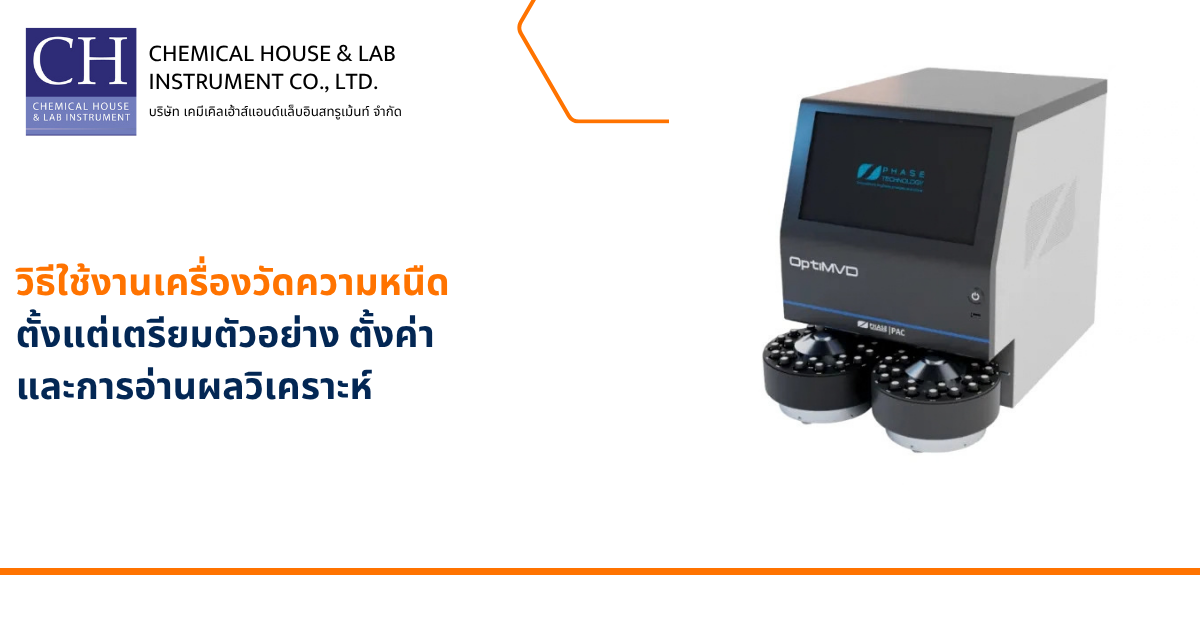
- OptiMVD Viscometer measures viscosity according to ASTM D7945. The method is based on the Hagen-Poiseuille principle for liquid flow through a horizontal capillary tube. The sample is taken from a closed sample bottle and transferred into a temperature-controlled measuring cell. The system uses optical sensors and a heating block around the measuring cell. It can also measure density according to ASTM D7777. The system supports samples with viscosity from 1 mm²/s to 2,000 mm²/s at 40°C and can handle up to 48 samples per loading.

- VISCOlab 3000 Viscometer from PAC performs automatic viscosity testing according to ASTM D7483. The series includes several models. VISCOlab 3000 is suitable for high-viscosity oil samples, VISCOlab 4000 is suitable for transparent oils, and VISCOlab PVT is designed for crude oil testing under high-temperature and high-pressure conditions.
Source:
https://th.rheonics.com/viscosity/
For more information, Add Line OA or scan the QR Code below.