
Sort by Product Catagories
- Bitumen/Asphalt Analysis
- Certificate Reference Material / Reference Material
- Chemical Analysis Equipment
- Coating Analyzer
- Lubricant & Grease Analysis
- Material Physical Testing
- Oil Physical Testing
- Petroleum & Petrochemical
- Process Online Analyzer
- Pulp Testing
- Sample Preparation
- Thermal Analysis Equipment
- Tribology Analysis
- Viscometers & Rheometers
Sort by Brands
- AC
- ACA
- AMC
- Applied Test System (ATS)
- Aro Scientific
- ASI Standard
- Cerulean
- Conidia
- Emcee
- Emco
- Emerson
- FP Innovation
- Frank PTI
- GBPI
- Gurley
- Hitachi
- KRK
- LGC
- Mat-Ing
- NETZSCH
- PAC
- PCS
- Phase Technology
- Pnshar
- PolyScience
- Precisepro
- PulMac
- Regmed
- RISE
- Scavini
- Servomex
- Spectro Scientific
- Sundy
- Thermo Fisher
- Thwing Albert
- Tobias
- USON
- Vived Management J&B
- Zematra
Distillation Apparatus
Distillation Apparatus
Chemihouse offers advanced, automated distillation apparatus and analyzers for the critical characterization of petroleum products, fuels, and chemicals. Developed in partnership with global leaders like PAC, our systems optimize laboratory efficiency while ensuring strict compliance with ASTM D86, D1160, and ISO standards.

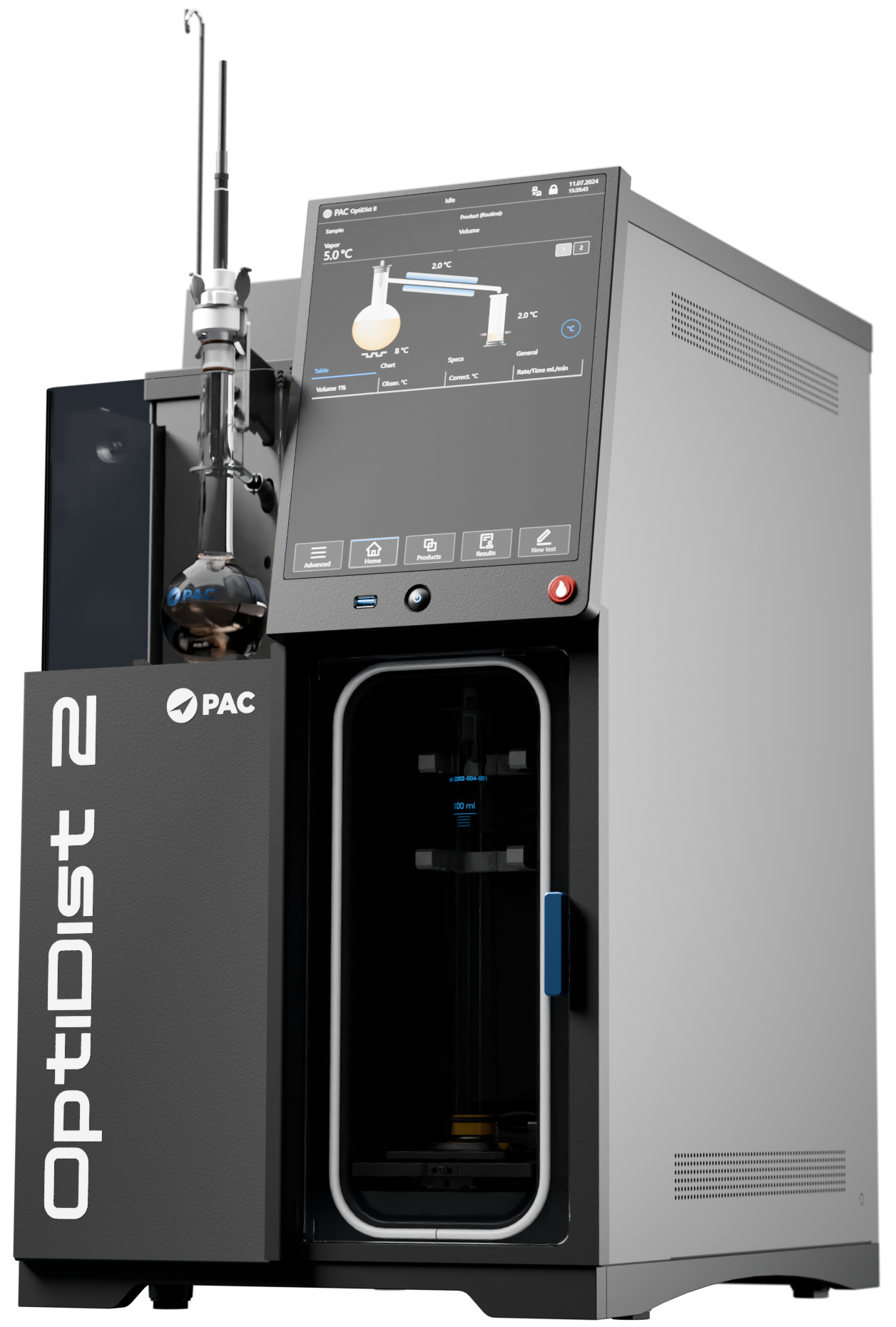


What is a Distillation Apparatus?
A distillation apparatus (or distillation analyzer) is a highly specialized laboratory instrument used to determine the boiling range characteristics and volatility of liquids—most notably petroleum fuels such as gasoline, diesel, jet fuel, and various industrial solvents. The system operates by heating a liquid sample to its boiling point, condensing the resulting vapors back into a liquid state, and continuously recording the temperature relative to the volume percentage recovered. The generated distillation curve provides crucial data regarding the composition, purity, and safety profiles of the products, ensuring they meet rigorous commercial and regulatory specifications.
How to Choose the Right Distillation Apparatus
Selecting the appropriate distillation analyzer for your laboratory or testing facility depends on several critical technical factors:
-
Standard Test Methods: Identify the specific regulatory standards your laboratory must comply with. For instance, Choose Atmospheric Distillation (e.g., OptiDist) for ASTM D86, D850, and D1078 testing of light-to-medium distillates, or Vacuum Distillation (e.g., HVD632) for ASTM D1160 testing of heavy fuel oils and biodiesel blenders.
-
Level of Automation: Fully automated distillation apparatuses significantly minimize human error, optimize temperature control, and automatically calculate barometric pressure corrections, whereas manual or semi-automated systems require constant operator monitoring.
-
Testing Speed and Sample Volume: If your laboratory requires rapid results for immediate process optimization, consider micro-distillation technologies (e.g., compliance with ASTM D7345) which yield highly accurate results in a fraction of the time using much smaller sample volumes.
-
Integrated Safety Features: Distillation involves high temperatures and flammable materials. Prioritize instruments equipped with advanced safety systems, including automatic fire extinguishing mechanisms, optical flask breakage sensors, and enclosed heating compartments.
Frequently Asked Questions about Distillation Apparatus (FAQ)
-
Q: What is the main difference between ASTM D86 and ASTM D1160 distillation?
-
A: ASTM D86 is conducted at normal atmospheric pressure and is ideal for light and middle distillate products like gasoline, gasohol, kerosene, and diesel. On the other hand, ASTM D1160 is performed under reduced pressure (vacuum condition). This is necessary for heavy petroleum products or lubricants with extremely high boiling points that would otherwise undergo thermal cracking (decompose or burn) before boiling under normal atmospheric conditions.
-
-
Q: Why is automated barometric pressure correction important in distillation testing?
-
A: Because the boiling point of any liquid shifts depending on ambient atmospheric pressure. Automated distillation apparatuses feature built-in barometers that automatically measure atmospheric pressure in real-time and correct the observed temperature readings according to ASTM guidelines, ensuring consistent and reproducible results regardless of the lab’s altitude or daily weather changes.
-
-
Q: What routine maintenance is required for automated distillation analyzers?
-
A: To maintain high precision, operators should routinely clean the glass distillation flasks to remove carbon residues, flush out the condenser tube to prevent cross-contamination, and regularly calibrate the temperature probes (PT100 sensors) and volume tracking systems using certified reference materials (CRMs).
-


