Different liquids do not flow in the same way. Some liquids flow quickly, while others are very thick and move slowly. These differences can have a major effect on product quality in many industries, including lubricants, paints, food, cosmetics, and chemicals.
This is why a Viscometer, or viscosity meter, is used to measure viscosity accurately before a liquid is used in production or real applications.
Knowing the correct viscosity helps manufacturers maintain product standards, prevent problems during flow, coating, and mixing, and keep production processes more stable. A viscometer is therefore an important instrument for quality control in many industries.
What Is a Viscometer?

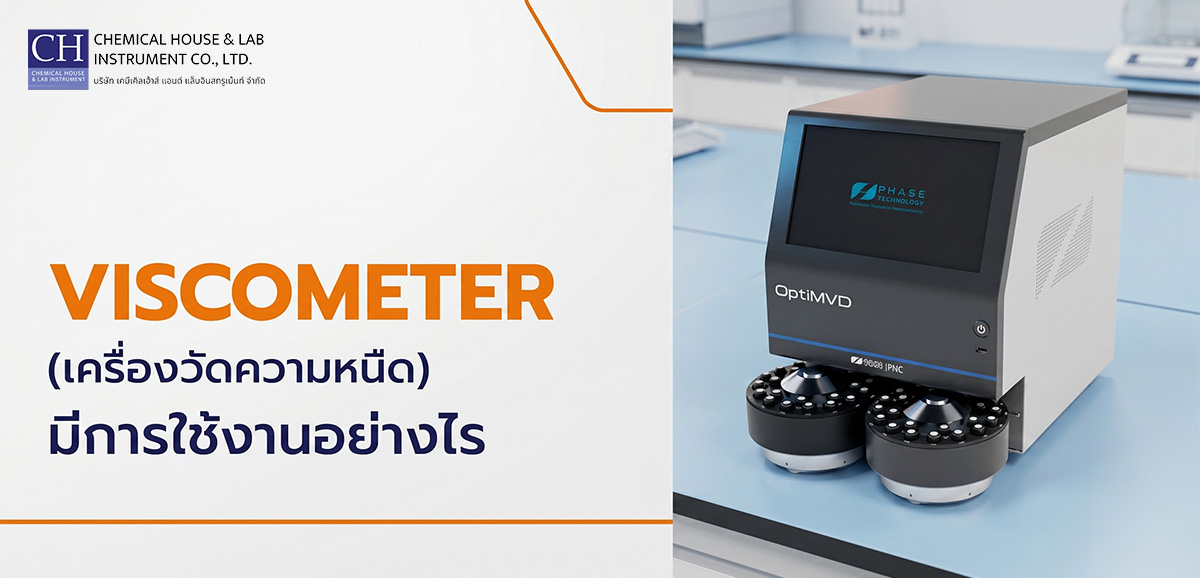
A Viscometer is an instrument used to measure the “viscosity” or flow resistance of a liquid. Viscosity is an important property because it affects production processes, product quality, and how a liquid performs during actual use.
There are several types of viscometers. Two common types are:
Rotational / Spindle Viscometer
This type rotates a spindle inside the liquid and measures how much resistance the liquid creates against the rotation. The higher the resistance, the higher the viscosity.
Capillary Viscometer
This type measures how fast a liquid flows through a narrow capillary tube by gravity. The flow time is directly related to the viscosity of the liquid.
A viscometer therefore helps us understand how easily or slowly a liquid flows. This information is important for quality control, product formulation, and production process design in many industries.
Methods for Measuring Viscosity
Viscosity can be measured in several ways. The best method depends on the type of liquid, the required accuracy, and the conditions of each industrial application.
Common methods include:
Capillary Viscometry
This method measures how a liquid flows through a narrow tube. However, the instrument must be properly calibrated, and the result can be strongly affected by changes in temperature.
Rotational Viscometry
This method measures the torque or resistance on a rotating spindle. Manual operation and sample conditions can affect measurement accuracy.
Falling Ball Viscometry
This method measures viscosity from the time required for a ball to fall through a tube filled with liquid. It is mainly suitable for transparent liquids, and disturbed flow may cause measurement errors.
Vibrational Viscometry
This method measures how a liquid affects the vibration of a sensor. It requires accurate calibration and may be affected by vibration from the surrounding environment.
Each method has its own advantages and limitations. Choosing the right type of viscometer for the liquid and production process helps provide more accurate and reliable results.
Factors to Consider When Choosing a Viscometer
Choosing the right viscometer is important for accurate viscosity measurement and practical use in industrial applications. The following factors should be considered.
Accuracy and Repeatability
A good viscometer should provide accurate and repeatable results while reducing errors caused by the operator.
This is especially important in industries that require strict control of product formulas or specifications, such as paints, food, and chemicals.
Performance and Automation
Many modern viscometers provide automatic functions such as temperature control, data recording, and result calculation.
These features help speed up testing, reduce complicated steps, and reduce errors from manual operation.
Ability to Measure Different Samples
Different industries work with different types of liquids.
For example:
- High-viscosity lubricants
- Fruit juice with particles
- Polymers that require temperature control
A viscometer that can measure a wide viscosity range and different types of samples can provide more flexibility in real applications.
Real-Time Data Analysis
Some viscometers can display results immediately and send data to control systems or analysis software.
This allows manufacturers to adjust production processes more quickly, such as changing a product formula during an in-line production process.
Cost Effectiveness
Some viscometers may have a higher starting cost. However, accurate measurement can reduce repeated testing, production errors, and product waste.
This can help reduce costs and improve quality in the long term.
Compliance with Industry Standards
A viscometer that follows international standards such as ASTM or ISO helps improve the reliability of measurement results.
Standard-compliant testing is also useful for quality control, product certification, and export requirements.
Choosing a viscometer is therefore not only about selecting the instrument with the highest measurement accuracy. It should also match the actual application, quality requirements, and standards of the industry.
Chemical House & Lab Instrument provides quality viscometers that support standard testing methods and can be used in many industries, including:
You can learn more about each product to compare the available options and choose the viscometer that best fits your application.
What Applications Can a Viscometer Be Used For?

Viscometers are widely used in many industries because many liquid products require viscosity control to maintain quality, consistency, and proper flow.
Common applications include:
Food, Beverage, Cosmetics, and Chemical Industries
Viscometers are used to check the viscosity of products that require consistent texture and flow, such as:
- Sauces, dipping sauces, and soups
- Creams, lotions, and gels
- Milk, oils, and chemical materials
Stable viscosity helps keep the texture, flow, and product performance within the required quality standard.
Research and Quality Control (QC / R&D)
A viscometer is an important instrument for studying how liquids behave under different conditions.
For example:
- Different shear conditions
- Changes in temperature
- Long-term formula stability
This information helps researchers and QC teams understand material properties and improve product formulas more accurately.
Non-Newtonian Fluids
Some liquids change their viscosity when shear is applied. These are called Non-Newtonian Fluids.
Examples include:
- Thick creams and chili sauce
- Some polymers
- Paints, emulsions, and suspensions
A suitable viscometer can measure these liquids under different shear stress and shear rate conditions. This helps users understand their flow behavior more accurately.
Because of its flexibility and measurement accuracy, a viscometer is an important instrument for industries that require strict liquid quality control and a better understanding of product flow behavior.
Related Article: What Is Polymer Testing and Why Is It Important in Industry?
Advantages of Using a Viscometer
Viscometers are flexible instruments that can be used in many different applications. Their main advantages include:
Can Measure Many Types of Liquids
A viscometer can measure many types of liquids, from low-viscosity liquids such as milk and fruit juice to high-viscosity products such as:
- Sauces
- Creams
- Industrial oils
- Pastes
- Concentrated chemicals
This makes the viscometer useful in many production and quality control applications.
Fast Results and Easy Operation
The measurement process can be simple depending on the type of viscometer.
For a rotational viscometer, the operator places the sample in the measuring area, lowers or inserts the spindle, starts the measurement, and reads the viscosity result.
This can reduce testing time and make routine viscosity measurements easier, especially for QC teams that need fast results.
Suitable for Laboratories, Factories, and On-Site Applications
Different viscometer designs can support different working environments, including:
- Laboratories for detailed analysis
- Factories for routine quality control
- On-site applications where suitable samples can be measured directly
A viscometer therefore helps improve measurement accuracy, product quality control, and understanding of liquid flow behavior.
Conclusion
In simple terms, a Viscometer is an important instrument used to measure the viscosity of liquids.
Viscosity can affect product quality, consistency, and performance in many industries, including food, cosmetics, lubricants, paints, chemicals, and other manufacturing processes where liquid flow must be carefully controlled.
There are several types of viscometers available today. Each type uses a different measurement method and has its own advantages and limitations. Choosing the right instrument depends on the liquid, measurement conditions, required accuracy, and industry standards.
Chemical House & Lab Instrument Co., Ltd. is a specialist in industrial measuring and testing instruments. We provide a wide range of solutions, from standard measuring instruments to advanced digital systems that can connect with production and laboratory systems to improve efficiency and reduce process losses.
We also provide complete after-sales services, including maintenance, calibration, and repair by our professional team. This helps ensure that your instruments continue to operate accurately and efficiently.
Because accurate measurement is an important part of quality control in every industry.
For more information or to request a quotation, please contact:
Chemical House & Lab Instrument Co., Ltd.
Tel: 02-184-4000
Website: https://chemihouse.com/
E-mail: info@chemihouse.com
Facebook: Chemical House & Lab Instrument
LINE OA: Scan the QR Code below