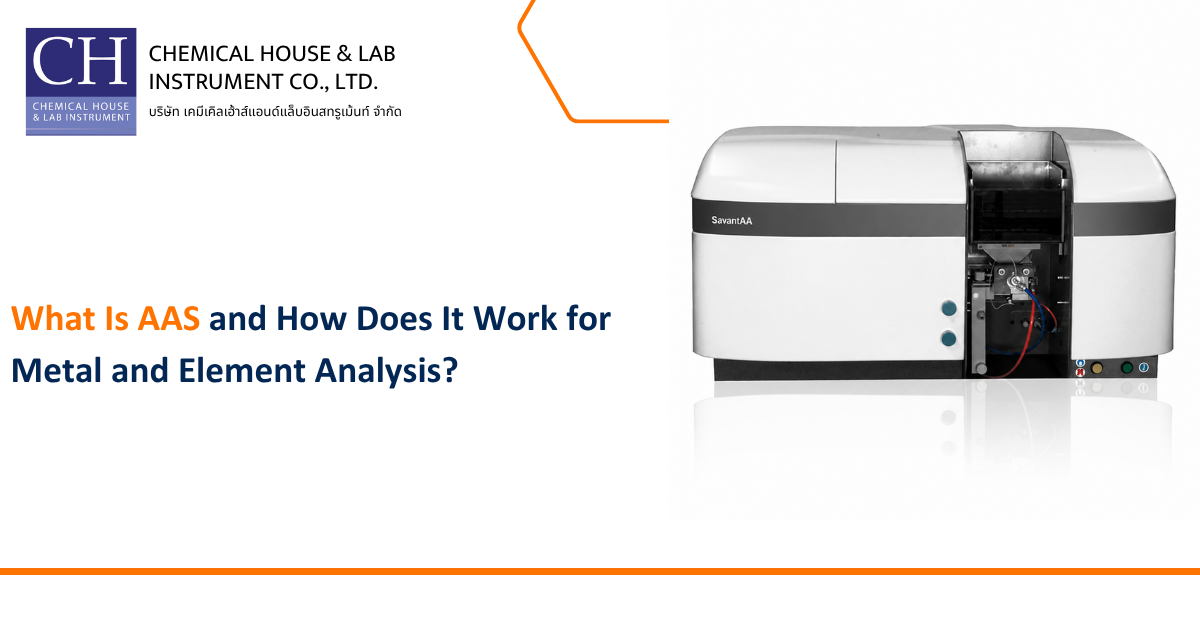
What Is AAS and How Does It Work for Metal and Element Analysis?
An AAS instrument is widely used for elemental analysis in laboratories, QC work, and many types of sample testing. It is especially useful when the concentration of specific elements needs to be measured, such as lead, cadmium, copper, iron, zinc, nickel, and other elements depending on the selected analytical method.
The basic principle of an AAS instrument is not to analyze the physical properties of a sample directly. Instead, the target element must first be converted into free atoms. Light at a wavelength specific to that element is then passed through the atoms, and the instrument measures how much light is absorbed. The Absorbance value is then used to calculate the concentration of the element in the sample.
Although AAS is often called a metal analyzer or heavy metal analyzer, it is not limited to heavy metals. The elements that can be analyzed depend on the Lamp, Atomization method, concentration range, and analytical Method being used.
What Is AAS and How Does It Analyze Elements by Light Absorption?
AAS stands for Atomic Absorption Spectroscopy. The instrument used for this technique is commonly called an Atomic Absorption Spectrophotometer or Atomic Absorption Spectrometer.
The technique measures how free atoms absorb light. It is based on the fact that atoms of each element absorb energy at their own specific wavelengths.
When light from the source passes through atoms of the target element, some of the light is absorbed. As a result, the intensity of light reaching the Detector decreases.
The instrument compares the light intensity before and after it passes through the atoms and converts this difference into an Absorbance value. This value is then used to determine the concentration of the element.
How Does an AAS Instrument Work?
From the start of the analysis to the final concentration result, the working principle of AAS can be divided into five main steps.
-
Select the Right Lamp for the Target Element
The analysis starts by selecting a light source that matches the element to be measured.
AAS commonly uses a Hollow Cathode Lamp (HCL), which produces spectral lines specific to an element. For example, if lead is being analyzed, the Lamp and wavelength must be set for Pb. If copper is being analyzed, the conditions must be selected for Cu.
The Lamp must match the target element because AAS requires light at wavelengths that the atoms of that element can specifically absorb.
Incorrect settings for the Lamp, wavelength, Lamp current, or Slit can affect measurement sensitivity and signal quality.
AAS models that support multiple Lamps can have several element Lamps installed at the same time. The system can then switch between Lamps according to the selected Method.
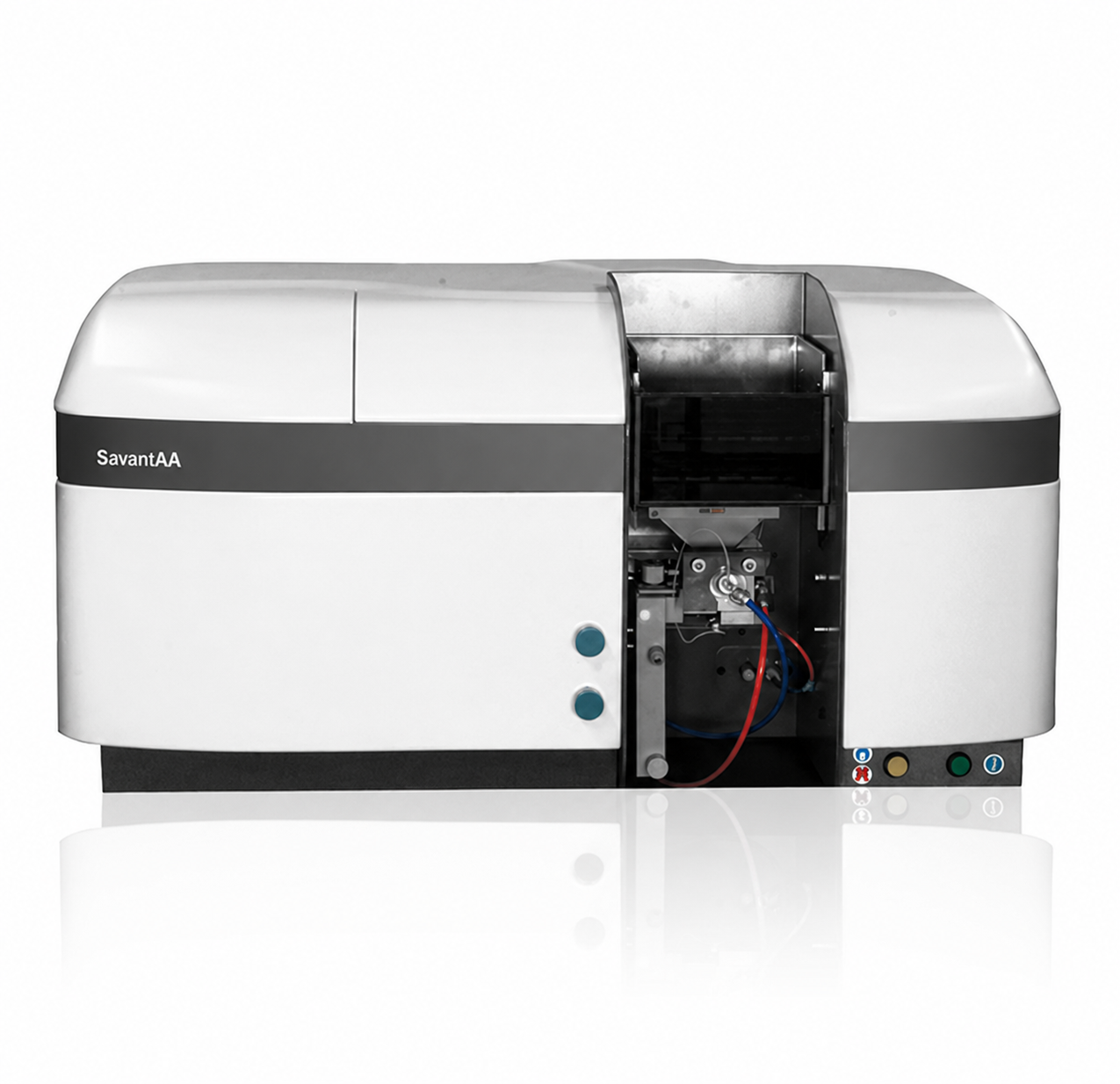
For example, SavantAA supports an 8-position Lamp Turret and can automatically select the required Lamp for Sequential multi-element analysis.
-
Convert the Sample into Free Atoms by Atomization
After selecting the target element and light source, the next important step is Atomization. This process converts the target element in the sample into free atoms that can absorb light.
In Flame AAS, a liquid sample is drawn into a Nebulizer, which converts it into a fine aerosol before it enters the flame. Inside the flame, the solvent evaporates, chemical compounds break down, and free atoms are formed.
In Graphite Furnace AAS, a small amount of sample is introduced into a Graphite Tube. The temperature is then controlled in several stages until the sample reaches the Atomization step.
Atomization directly affects the analytical result because AAS does not measure the element while it remains in its original solution form. The system must first create conditions that allow the target element to become free atoms capable of absorbing light.
For this reason, the Flame Atomization system of an AAS instrument must properly control sample introduction, aerosol formation, and flame conditions according to the analytical Method.
-
Measure Absorbance at the Element-Specific Wavelength
Once free atoms have been formed, light from the Lamp passes through the area containing the sample atoms.
The atoms of the target element absorb light at wavelengths related to their specific energy transitions. This reduces the intensity of light after it passes through the atoms.
The instrument compares the incoming light intensity with the remaining light intensity after passing through the sample and expresses the result as Absorbance.
Within a suitable analytical range, the more atoms of the target element present in the Optical Path, the more light will be absorbed.
This principle allows AAS to use light absorption signals for quantitative elemental analysis.
-
Separate and Detect the Signal with a Monochromator and Detector
The light entering the Optical system may contain more than just the signal required for the analysis.
A Monochromator is therefore used to separate wavelengths and select the appropriate wavelength for the target element before the light reaches the Detector.
The Detector measures the light intensity and converts it into an electrical signal for further processing.
AAS systems may use a Photomultiplier Tube (PMT) as the Detector for measuring light signals.
For example, the Optical system of SavantAA uses an Ebert-Fastie Monochromator together with a Photomultiplier Tube. It also uses a Double Beam optical system, allowing the instrument to monitor both the sample signal and reference signal during measurement.
In simple terms, the Monochromator can be thought of as the part that selects the light to be measured, while the Detector measures how much of that light remains before the data is sent to the Software.
This is also a basic principle used in Spectrometer instruments.
-
Calculate Element Concentration from Absorbance and the Calibration Curve
An Absorbance value alone is not yet the concentration of an element.
For quantitative analysis, standards with known concentrations must first be prepared. Their Absorbance values are measured under the same conditions as the samples to create a Calibration Curve.
Within a suitable response range, Absorbance is related to element concentration according to Beer’s Law.
In real applications, however, the Calibration Curve may not always remain linear across all concentration ranges. Several factors can cause deviation from linearity.
For this reason, the Calibration range and Standards should be selected and checked according to the Method instead of assuming that all concentrations will always produce a linear response.
When a sample is measured, the Software compares its Absorbance with the Calibration Curve and calculates the concentration.
The system may also apply the Dilution Factor or other information related to sample preparation according to the selected Method.
The Software used with an AAS instrument for elemental analysis can also manage Calibration, Standards, Samples, and QC within the analytical workflow.
How Can AAS Analyze Different Metals and Elements?
One important point to understand is that AAS can analyze many different elements, but traditional AAS is generally an element-specific analysis technique.
This means the instrument selects the Lamp, wavelength, and Method for the element being measured before moving on to the next element.
AAS instruments with a Lamp Turret and automatic control systems can therefore make Sequential multi-element analysis more convenient. However, the principle is still different from techniques that measure the spectra of several elements at the same time.
The choice between Flame, Graphite Furnace, and Hydride systems depends on the target element, concentration level, sample Matrix, and required Detection Limit.
Flame AAS for Flame-Based Elemental Analysis
Flame AAS is one of the most widely used AAS techniques.
A liquid sample is drawn into a Nebulizer and Spray Chamber before entering the flame, where free atoms are produced. The instrument then measures light absorption by the target element.
Different flame types can be used depending on the Method, such as Air-Acetylene or Nitrous Oxide-Acetylene, because different elements may require different Atomization conditions.
Flame AAS is suitable for Routine analysis where many samples need to be measured and the concentration levels are within the measurement range of the technique.
Applications may include raw material quality control, environmental testing, food analysis, oil testing, or the analysis of properly prepared solutions from metal samples.
Graphite Furnace for Low-Concentration Element Analysis
Graphite Furnace AAS, or GFAAS, uses a Graphite Tube as the Atomization area instead of a flame.
Only a small amount of sample is introduced into the Tube. The temperature is then increased according to a programmed sequence such as Drying, Ashing, and Atomization.
One major advantage is that the atoms of the target element remain in the Optical Path for a longer period. The sample is also not continuously carried through a flame.
As a result, GFAAS can measure elements at lower concentrations than Flame AAS.
GFAAS is commonly used for many elements at the ppb level, while some Graphite Furnace systems can support analysis below the ppb level depending on the Method and target element.
However, higher sensitivity also requires better control of the sample Matrix, Temperature Program, Chemical Modifier, and sample contamination.
Hydride Generation and Mercury Analysis for Specific Elements
Some elements can be analyzed with higher sensitivity using Hydride Generation.
In this technique, the target element is converted into a volatile Hydride compound and transferred into an Absorption Cell for measurement.
Elements that can be analyzed using Hydride Generation include Arsenic (As), Selenium (Se), Antimony (Sb), Bismuth (Bi), Tellurium (Te), Tin (Sn), Germanium (Ge), and Lead (Pb) under suitable analytical Methods.
Mercury (Hg) can be analyzed using the Cold Vapour Technique, which is specifically designed for mercury analysis.
These systems expand the capabilities of an AAS instrument for metal and elemental analysis by allowing the sample introduction and Atomization method to be selected according to the target element and required Detection Limit.
Factors That Affect the Accuracy of AAS Analysis
Although the basic principle of AAS is straightforward, the quality of the analytical result does not depend only on the instrument.
Every step from sample preparation to Calibration can introduce errors.
Important factors that should be controlled include:
- Sample Preparation – Solid samples often need to be converted into a solution before analysis. Incomplete digestion or loss of the target element can cause inaccurate results.
- Sample Matrix – Other components in the solution may interfere with Atomization or light absorption.
- Atomization Conditions – These include gas flow rate, Burner position, sample aspiration rate, and the Temperature Program used for Graphite Furnace analysis.
- Lamp and Optical Settings – Important settings include the selected Lamp, Lamp current, wavelength, Slit, and Optical system alignment.
- Calibration Standards and Blank – Standards should match the required concentration range and sample Matrix. QC Samples should also be used to check analytical accuracy during the run.
- Background and Interference – The measured signal may not come only from atoms of the target element. The correct Background Correction technique and analytical Method should therefore be selected.
- Contamination and Carryover – These are especially important in Trace analysis. Contamination from containers, reagents, or sample preparation steps can significantly affect the measured result.
Optimizing the Lamp, Burner, and sample introduction system, together with checking the Blank, Standards, and Calibration, is an important part of AAS quality control.
For laboratories developing a Method or selecting the right configuration of an AAS instrument for laboratory analysis, the starting point should be the target elements, concentration range, sample Matrix, number of samples per day, and required Detection Limit rather than instrument specifications alone.
What Is the Difference Between AAS, OES, and XRF for Metal Analysis?
AAS, OES, and XRF can all be used to identify or measure elements, but they use different analytical principles and are suitable for different applications.
For this reason, an instrument should not be selected simply because it is described as a “metal analyzer.”
| Topic | AAS | Arc/Spark OES | XRF |
| Principle | Measures light absorbed by free atoms | Measures light emitted by atoms after excitation by Arc/Spark | Measures X-ray Fluorescence emitted by the sample |
| Common Samples | Solutions or samples prepared in a form suitable for the sample introduction system | Metal samples with properly prepared surfaces | Solids, powders, or liquids depending on the instrument and Method |
| Multi-Element Analysis | Generally measures specific elements one at a time in sequence | Quickly analyzes multiple elements from the metal spectrum | Can analyze multiple elements in one measurement |
| Suitable Applications | Analysis of specific elements, especially Trace analysis in samples prepared as solutions | Metal composition analysis, grade identification, and alloy control | Rapid material screening and elemental composition analysis |
| Sample Preparation | Often requires sample preparation or digestion | Metal surfaces must be prepared for Spark analysis | Generally requires less sample preparation than AAS, depending on the required accuracy |
| Effect on Sample | Uses part of the sample and often requires sample preparation | Leaves a mark at the Spark location | Non-destructive technique |
For OES used directly on metal samples, the principle is to excite atoms on the surface using Arc/Spark and then analyze the spectrum of emitted light.
This makes OES suitable for chemical composition analysis and metal grade identification.
XRF uses X-rays to excite atoms in the sample and analyzes the resulting X-ray Fluorescence.
One of its main advantages is fast analysis with Non-destructive testing. It is therefore suitable for material sorting, incoming material inspection, and applications where the sample needs to remain intact after analysis.

![[2026 Update] Thai Industrial Standards (TIS) for Steel and Metal Products](https://chemihouse.com/wp-content/uploads/2026/10/2026-Update-Thai-Industrial-Standards-TIS-for-Steel-and-Metal-Products.png)