
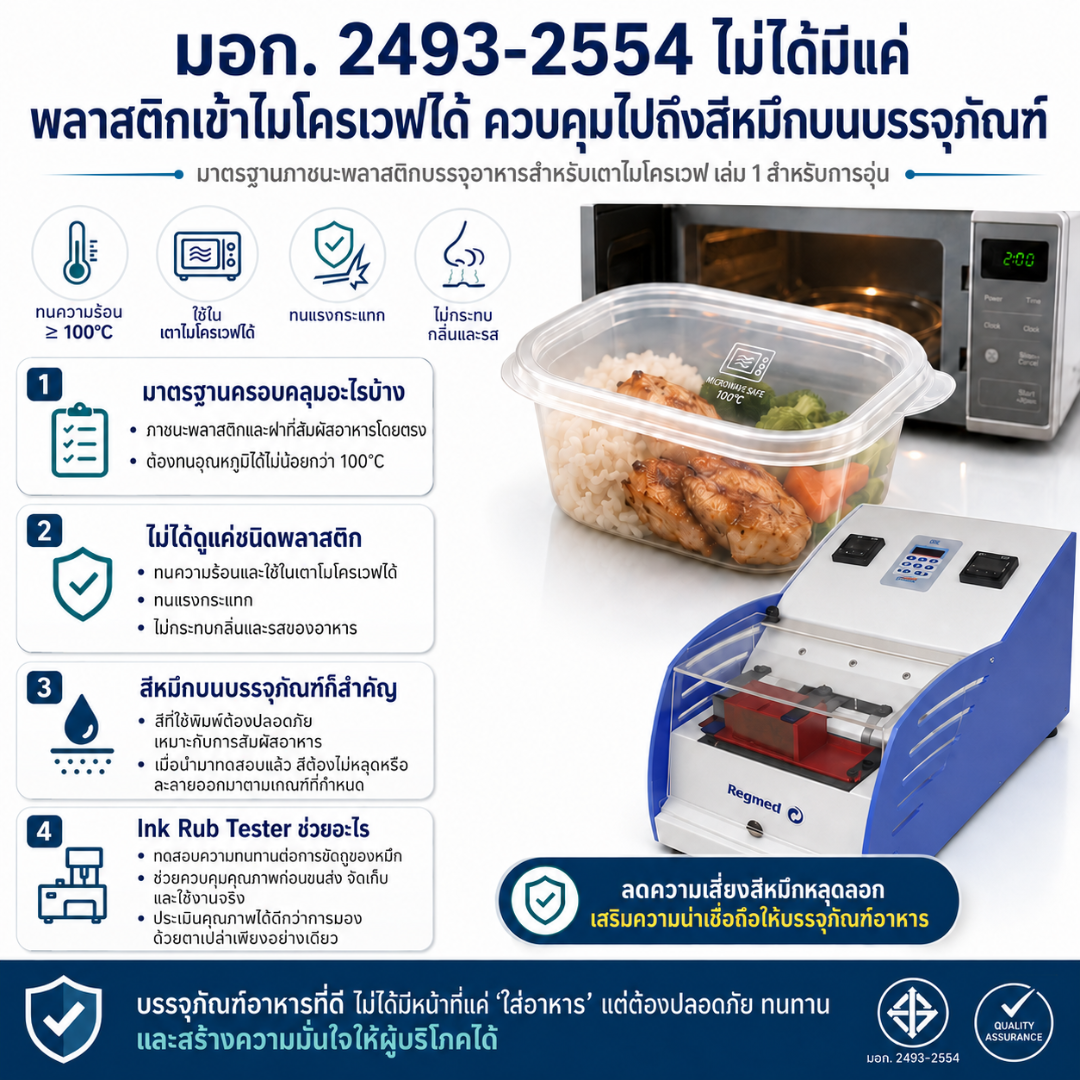
TISI 2493 Part 1-2554 is the Thai Industrial Standard for plastic food containers used for reheating food in microwave ovens. It is an important standard that plastic container manufacturers should understand and follow correctly.
What Is TISI 2493 Part 1-2554?
TISI 2493 Part 1-2554 covers plastic food containers and lids that come into direct contact with food during microwave reheating. The containers must be able to withstand temperatures of at least 100°C.
The standard covers four types of plastic:
- Polypropylene, or PP
- Polyethylene terephthalate, or PET
- Polymethyl methacrylate, or PMMA
- Polymethylpentene, or PMP
To meet TISI 2493 Part 1-2554, a container must do more than simply withstand microwave heating. The standard also covers its general condition, strength, safety, and performance during use.
Performance Requirements
Microwave Use
The container must not show any unusual changes or damage that could affect its safe use in a microwave oven.
Heat Resistance
The container must withstand temperatures of at least 100°C. It must not warp, shrink, wrinkle, or change shape in a way that affects its use.
Impact and Usage Resistance
The container must not crack or break during testing. It must also keep its shape and remain suitable for normal use.
Odour and Taste
The container must not transfer an unpleasant smell or taste to the food.
How Is Packaging Ink Related to TISI 2493-2554?
An important point that packaging manufacturers should not overlook is the ink printed on the container and the colour added to the plastic material.
TISI 2493-2554 clearly includes safety requirements for both printed ink and colourants used in plastic.
The Ink Must Be Food-Contact Grade
The ink printed on the container and the colourants mixed into the plastic must be suitable for food-contact use. They must be safe and must not cause harm to consumers.
Manufacturers must be able to provide a quality certificate or test report issued by an institute or organisation accepted by the Thai Industrial Standards Institute.
Printed Ink Durability
For printed ink durability, Clause 8.8 of TISI 2493-2554 requires a test using crepe adhesive tape.
The tape is applied to the printed area and then pulled off immediately in a vertical direction. The tape is then checked to see whether any printed ink has come off the container.
Colourants in Plastic Must Not Migrate Above the Specified Limit
According to Clause 8.9 of TISI 2493-2554, the colour of the solution taken from the sample must not be darker than the reference solution used for comparison.
This test helps check whether colourants from the plastic migrate into the test solution above the allowed level.
Ink Rub Tester for Packaging Print Quality Control
An Ink Rub Tester is used to check how well printed ink and printed surfaces can resist rubbing and friction.
During the test, the rubbing head moves back and forth across the sample under controlled conditions, including weight, speed, temperature, and number of cycles.
The RAS-21 Ink Rub Tester allows users to set the test speed and number of cycles. The temperature of the test base plate can also be adjusted.
The instrument supports test methods based on ASTM D5264 and TAPPI T-830. It is suitable for testing printed materials that may be damaged by rubbing during transportation, storage, handling, or normal use.
The Ink Rub Tester is useful for internal quality control because it gives manufacturers a clear and repeatable way to compare ink performance, printing conditions, and packaging materials.
However, the Ink Rub Tester is used to test resistance to rubbing and should not be considered a direct replacement for the adhesive tape test specified in Clause 8.8 of TISI 2493-2554.
For packaging, printing, paper, plastic, and label manufacturers that want to improve their quality control process, further information about the Ink Rub Tester is available from Chemical House.
Tel: 02-184-4000
Email: info@chemihouse.com
Line OA: @chemihouse_th
Facebook: Chemical House & Lab Instrument