
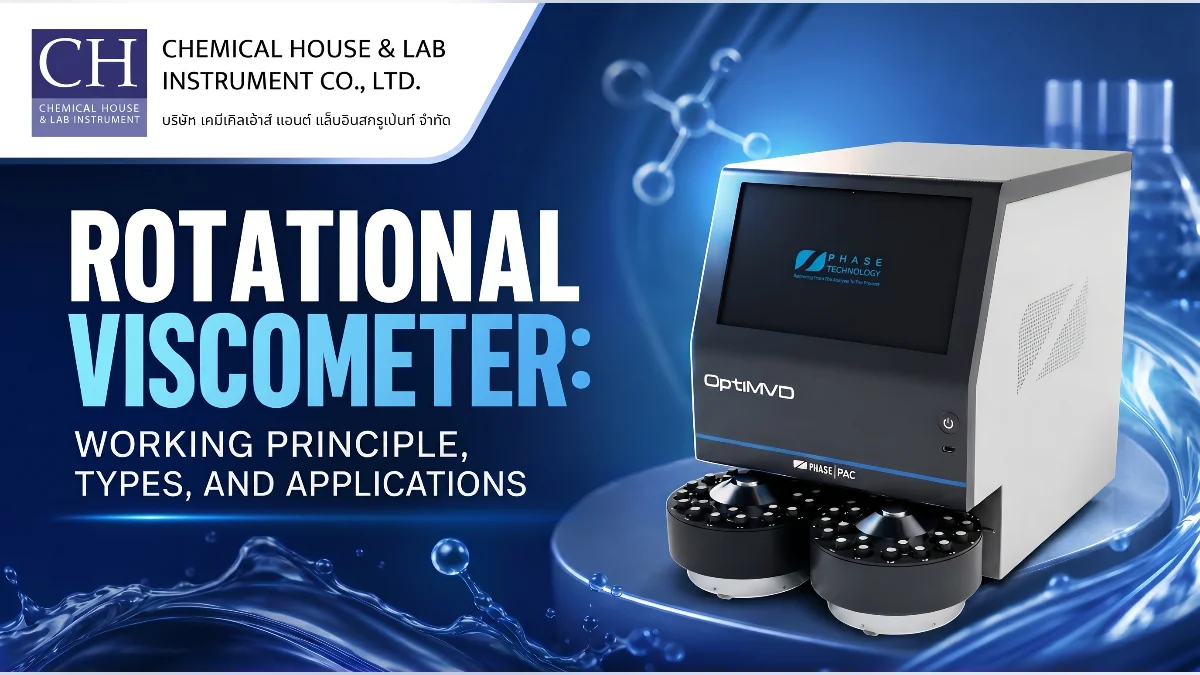
Viscosity describes how much a fluid resists flow. Low-viscosity fluids like water move easily, while high-viscosity materials such as honey, creams, paints, or lubricants flow more slowly.
In many industries, viscosity measurement is essential for quality control, process stability, and product performance. It helps manufacturers understand how a material will mix, pump, spread, fill, or behave during use.
A Rotational Viscometer is one of the most commonly used instruments for measuring viscosity. It works by rotating a measuring element inside a sample and detecting the resistance created by the fluid.
Because it can measure both Newtonian and non-Newtonian fluids, a rotational viscometer is widely used across laboratories, manufacturing lines, and R&D environments where accurate flow behavior analysis is required.
What is a Rotational Viscometer?
A rotational viscometer is an instrument used to measure the viscosity of liquids and semi-solid materials by analyzing how much resistance they create against rotational movement. It is commonly used in laboratories, quality control, and production environments to evaluate how easily a material flows under controlled conditions.
The core principle is simple: a spindle, cylinder, cone, or disc is immersed in a fluid sample and rotated at a defined speed. As the measuring element turns, the fluid resists its movement. The instrument detects this resistance, or torque, and converts it into a viscosity value. The higher the resistance, the higher the viscosity of the material.
Rotational viscometry became widely adopted because it helped overcome some limitations of older methods such as capillary and falling-ball viscometers. While those methods are useful for certain simple fluids, they are less flexible when testing thicker materials, structured fluids, or products whose viscosity changes under different shear conditions. Rotational viscometers offer greater control over test speed, shear rate, temperature, and sample behavior, making them especially valuable for modern industries dealing with both Newtonian and non-Newtonian fluids.
The Working Principle of Rotational Viscometry
Torque and Angular Velocity
Rotational viscometry works by placing a spindle or measuring geometry into a fluid sample and rotating it at a controlled speed. As the spindle turns, the fluid creates drag against its movement. This resistance generates torque, which is measured by the instrument.
In many rotational viscometers, a motor drives the spindle through a calibrated spring or sensing system. The more the fluid resists the spindle’s rotation, the greater the torque detected. A low-viscosity fluid creates less resistance, while a high-viscosity fluid produces stronger drag and higher torque.
Mathematical Relation
The basic idea behind viscosity measurement is the relationship between shear stress and shear rate.
Shear stress refers to the force needed to move one layer of fluid over another, while shear rate describes how quickly those layers move relative to each other. In a rotational viscometer, torque is used to determine shear stress, and rotational speed is used to determine shear rate.
Dynamic viscosity, often represented by η, can be simplified as:
Viscosity (η) = Shear Stress / Shear Rate
This means viscosity expresses how much resistance a fluid shows when it is subjected to controlled movement.
Viscosity Calculations
The final viscosity value is calculated based on the spindle geometry, rotational speed, measured torque, and instrument calibration. For simple Newtonian fluids, viscosity remains relatively constant at different speeds. For non-Newtonian fluids, viscosity may change depending on the applied shear rate, which is why rotational viscometers are useful for analyzing real-world product behavior.
Common viscosity units include centipoise (cP) and Pascal-seconds (Pa·s). In practice, 1 Pa·s = 1,000 cP, making both units widely used in laboratories, quality control, and industrial testing.
Key Components of a Rotational Viscometer
A rotational viscometer is built from several key components that work together to measure flow resistance accurately
- Drive Motor: Controls the rotational speed of the spindle, usually measured in RPM. Stable speed control is important for repeatable viscosity results.
- Calibrated Spring / Torque Sensor: Measures the resistance created by the fluid as the spindle rotates. Higher resistance indicates higher viscosity.
- Spindle (Rotor): The measuring element immersed in the sample. Spindles come in different geometries, such as cylinder, disc, cone-plate, or vane designs, depending on the fluid type, viscosity range, and testing purpose.
- Sample Container: Holds the fluid sample during measurement. The container size and shape can affect test consistency, especially for small-volume or high-viscosity samples.
- Temperature Control Jacket: Helps maintain a stable sample temperature during testing. This is critical because viscosity can change significantly with even small temperature fluctuations, especially in oils, polymers, cosmetics, and food products.
Main Types of Rotational Viscometers and Spindle Geometries
Concentric Cylinder (Coaxial) Viscometers
Concentric cylinder viscometers use an inner cylinder rotating inside an outer cylinder, with the fluid sample placed in the narrow gap between them. This setup provides well-defined flow conditions and precise shear rate control.
They are especially suitable for low-viscosity fluids, such as solvents, oils, inks, and liquid chemicals, where accuracy and repeatability are important.
Cone and Plate Viscometers
Cone and plate viscometers use a shallow cone rotating against a flat plate, with a thin layer of sample placed between the two surfaces. This geometry requires only a small sample volume and creates a uniform shear rate across the sample.
Because of this, cone and plate systems are commonly used for absolute viscosity measurement, especially in laboratories, R&D, pharmaceuticals, cosmetics, and high-value materials where sample quantity is limited.
Parallel Plate Geometry
Parallel plate geometry uses two flat plates with the sample placed between them. One plate rotates while the other remains stationary. This design is useful for materials that are too thick or structured for narrow-gap systems.
It is often used for high-viscosity materials, pastes, gels, creams, adhesives, and fluids containing small particles. The adjustable gap also makes it practical for testing materials with different textures or particle sizes.
Brookfield-type Disc and Cylindrical Spindles
Brookfield-type rotational viscometers are among the most widely used systems for routine viscosity testing. They use interchangeable disc or cylindrical spindles rotated directly in a sample container.
This method is considered a relative viscosity measurement, meaning results depend on the spindle type, speed, sample container, and testing conditions. It is not always used for highly precise rheological analysis, but it is extremely practical for quick quality control checks.
Because of its simplicity, flexibility, and ease of use, the Brookfield-type viscometer is commonly found in production lines and QC laboratories for paints, coatings, food products, cosmetics, lubricants, and chemicals.
Industrial Applications of Rotational Viscometers
Rotational viscometers are widely used across industries where fluid consistency, process control, and final product performance are critical. Because they can test a broad range of materials, from thin liquids to thick pastes, they are useful in both laboratory and production environments.
Food & Beverage
In the food and beverage industry, rotational viscometers help measure the consistency and flow behavior of products such as sauces, dairy products, chocolate, syrups, dressings, and beverages. Viscosity control ensures that products have the right mouthfeel, pourability, texture, and processing stability.
Pharmaceuticals & Cosmetics
For pharmaceuticals and cosmetics, viscosity directly affects product usability, dosage consistency, and customer experience. Rotational viscometers are used to test lotions, creams, gels, ointments, shampoos, liquid medicines, and suspensions to ensure they spread, dispense, and remain stable as intended.
Paints, Inks, and Coatings
In paints, inks, and coatings, viscosity influences how a product is mixed, pumped, sprayed, rolled, or applied to a surface. Rotational viscometers help evaluate key performance factors such as leveling properties, sag resistance, film formation, and pumpability, making them essential for quality control and formulation development.
Chemical & Petroleum
In chemical and petroleum applications, rotational viscometers are used to test materials such as polymers, lubricants, crude oil, resins, adhesives, and specialty chemicals. These measurements help engineers understand how materials behave during processing, transport, storage, and end-use conditions.
Advantages and Limitations
Rotational viscometers are valued for their flexibility and practical use across many industries. However, like any analytical instrument, they require proper handling, calibration, and test control to produce reliable results.
| Aspect | Details |
| Advantages | Continuous measurement: Allows users to monitor viscosity behavior over time or under changing test conditions. |
| Wide viscosity range: Suitable for low-viscosity liquids, high-viscosity materials, gels, creams, pastes, and semi-solid products. | |
| Useful for non-Newtonian fluids: Can evaluate shear-thinning and shear-thickening behavior by testing samples at different rotational speeds. | |
| Practical for QC and R&D: Commonly used in both routine quality control and formulation development. | |
| Automated data logging: Many modern instruments can record, export, and analyze viscosity data for better traceability. | |
| Limitations | Higher initial cost: More expensive than simple glass capillary or falling-ball viscometers. |
| Requires careful cleaning: Residual sample on the spindle or measuring geometry can affect accuracy and repeatability. | |
| Temperature-sensitive results: Viscosity can change significantly with temperature, so temperature control is essential. | |
| Method-dependent results: Spindle type, speed, sample volume, container size, and test setup must be consistent for reliable comparison. |
In practice, the advantages usually outweigh the limitations when a process requires repeatable, controlled, and application-relevant viscosity measurement. For the best results, users should standardize the test method, control temperature, select the correct spindle geometry, and clean the instrument properly after each measurement.
Frequently Asked Questions (FAQs)
What is the difference between a rotational viscometer and a rheometer?
A rotational viscometer is mainly used to measure viscosity under defined rotational speeds. It is ideal for routine quality control, production checks, and basic flow behavior analysis.
A rheometer, on the other hand, offers broader testing capabilities. In addition to viscosity, it can measure more complex material properties such as elasticity, viscoelastic behavior, yield stress, creep, recovery, and oscillation response. In simple terms, a viscometer tells you how easily a material flows, while a rheometer gives deeper insight into how a material deforms and behaves under different forces.
Why is temperature control so critical in rotational viscometry?
Temperature has a strong effect on viscosity. Many fluids become thinner when heated and thicker when cooled. Even a small temperature change can lead to a noticeable difference in viscosity results, especially for oils, polymers, cosmetics, food products, and pharmaceutical formulations.
This is why temperature control is essential for repeatable and comparable measurements. A sample should be tested under the same temperature conditions every time, especially when results are used for quality control, batch comparison, or product specification.
How do I choose the right spindle for my sample?
The right spindle depends on the sample’s viscosity range, texture, volume, and testing purpose. Low-viscosity fluids usually require larger surface-area spindles or geometries designed for better sensitivity, while high-viscosity materials often need smaller spindles, vane spindles, or plate geometries that can handle stronger resistance.
For routine QC, Brookfield-type disc or cylindrical spindles are commonly used because they are simple and practical. For more precise shear rate control, cone-plate or concentric cylinder geometries may be more suitable. The best practice is to choose a spindle and speed combination that keeps the torque reading within the recommended operating range of the instrument.
Conclusion
A rotational viscometer is an essential tool for measuring how fluids and semi-solid materials behave under controlled conditions. By detecting resistance to rotation, it helps manufacturers and laboratories control viscosity, improve consistency, and support product development.
Its versatility makes it suitable for both Newtonian and non-Newtonian fluids across industries such as food, pharmaceuticals, cosmetics, paints, chemicals, and petroleum.
For reliable results, users should choose the right spindle, control temperature carefully, and follow a consistent testing method. The right rotational viscometer can improve quality, efficiency, and long-term process stability.
Chemical House & Lab Instrument Co., Ltd. is a specialist in industrial measuring instruments, with a deep understanding of the specific needs of each manufacturing sector.
We develop and distribute comprehensive measurement solutions, ranging from standard gauges to advanced digital systems that can seamlessly integrate with your existing infrastructure. Our solutions are designed to enhance operational efficiency and reduce losses throughout the production process.
In addition, we provide complete after-sales services, including maintenance, calibration, and repair by a professional team, ensuring that your instruments continue to operate reliably and at maximum efficiency.
Because accuracy is the foundation of success in every industry.
For inquiries or quotation requests, please contact:
Chemical House & Lab Instrument Co., Ltd.
Tel: (662) 184-4000
Call Center: +66 (0)88 088 4399
Authorized Distributor of Testing Instruments
Website: Chemical House & Lab Instrument Co., Ltd.
E-mail: ptsales@chemihouse.com or info@chemihouse.com
Facebook: ch.chemicalhouse
Line OA: via the QR code below.


![[2026 Update] Thai Industrial Standards (TIS) for Steel and Metal Products](https://chemihouse.com/wp-content/uploads/2026/10/2026-Update-Thai-Industrial-Standards-TIS-for-Steel-and-Metal-Products.png)


